SKIP TO MAIN

Policy and Community Insight | March 11, 2026

Lingering Fear: Immigration Enforcement Tactics Harm Families—and Communities Respond

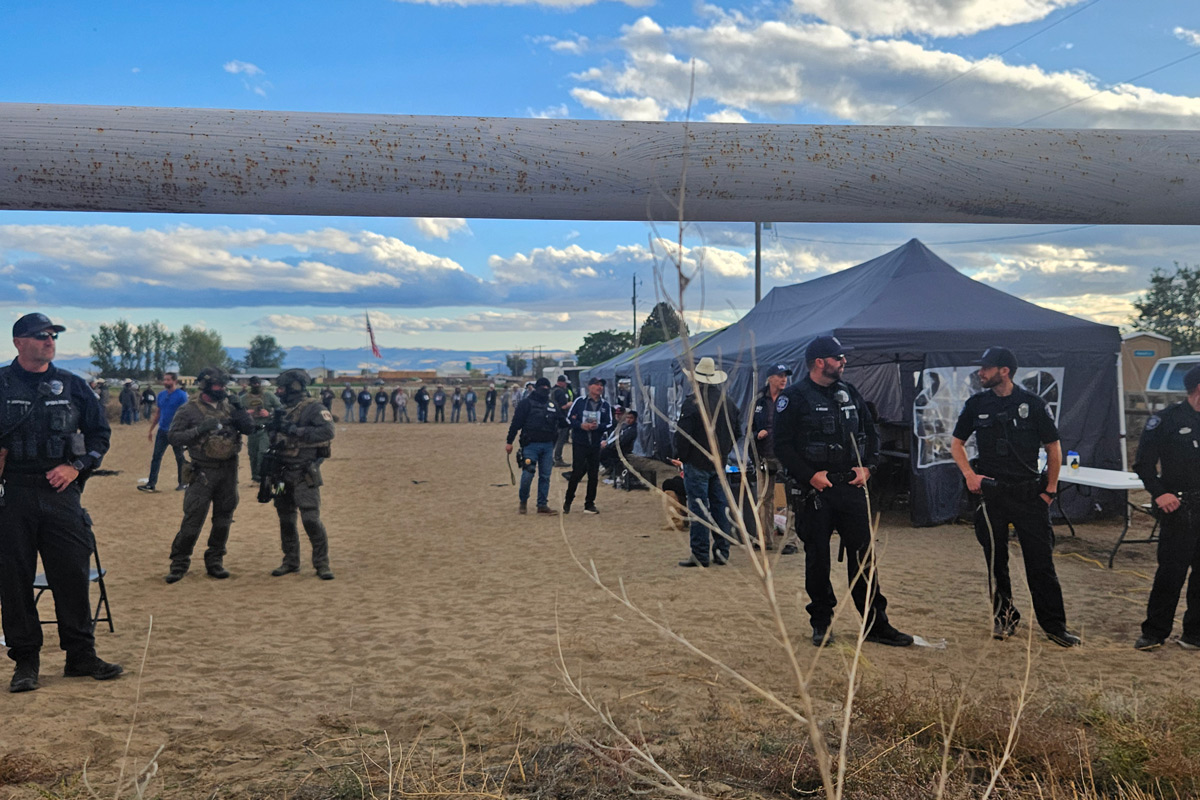
Federal, state, and local law enforcement officers, including the FBI and ICE, conducted a raid on the La Catedral horse racing arena in Wilder, ID, on Oct. 19, 2025, detaining nearly all those in attendance. Photo courtesy of the ACLU of Idaho.

MONTHS AFTER FEDERAL AGENTS BURST INTO A WEEKEND EVENT at the La Catedral horse racing arena in Wilder, ID, Rosseli Guerrero was still waking in the middle of the night from occasional nightmares, her mind racing with scenes of masked men and crying children. And she hadn’t even been there. She was among the ACLU of Idaho staff who answered an emergency hotline the organization quickly created after the raid to help families locate detained loved ones and offer support.

Children’s voices now haunt her the most. Often an eldest daughter or son made those first frantic calls, translating if needed, and many struggled to keep their composure. Sometimes, the children themselves had witnessed what’s become known as the Wilder raid, one of a growing number of immigration actions to employ military-style tactics. More than 200 officers descended on the roughly 400 people attending the popular gathering, wielding military rifles, firing rubber bullets, separating families, and zip-tying children and adults alike.

The aggression used there has played out elsewhere, most notoriously in Operation Metro Surge on the wintery streets of the Twin Cities. There the tactics have stirred tension, especially after agents fatally shot two demonstrators in separate incidents mere weeks apart. From Wilder and Minneapolis to rural and urban areas across the country, fear has permeated far beyond those targeted for deportation. And the militant, sometimes violent, actions of federal agents have generated not just detentions and arrests, but also a deep unease. Yet these same conditions have spurred organizing, legal advocacy, and community support.

From Wilder, ID, and Minneapolis to rural and urban areas across the country, fear has permeated far beyond those targeted for deportation.
THE FIRST STORY IN OUR SERIES

When Policy Hits Home:
The Impact on Community

Support carries on long after federal agents leave.

At Wilder, “A Sunday community event where people went to relax instead became a war zone,” said Leo Morales, executive director of the ACLU of Idaho. Agents detained nearly all of those in attendance, many of them US citizens and children. With a helicopter overhead, at least one officer on horseback, and camouflage-clad agents breaking car windows, it looked like a battlefield. Morales noted, “We have experienced immigration enforcement in the past. This time, it has been very different.”

The ACLU of Idaho is now representing a group of people who recently filed a lawsuit against the federal government for civil rights violations based on wrongful detention and maltreatment during the Wilder raid. The ACLU of Idaho is also leading community efforts to support impacted families.

Get the full “When Policy Hits Home” series

In the days following the raid, the ACLU’s hotline was flooded with calls and was key in getting families immediate material and emotional support. A month later, the organization hosted a three-hour group counseling session with a dozen volunteer bilingual counselors who separated participants into three groups: adults, young adults, and children. Though engaged in art projects, many children eventually grew anxious when separated from parents. Counselors calmed them by taking “field trips,” so they could look through a window into the adult meeting.

Stress over family separation ripples through every age group.

In Washington state, a 60-year-old Mexico-born grandmother described a life on edge to her advocates at OneAmerica, a statewide immigrant rights organization. “Every time I step outside, my heart pounds,” she said, worried about encountering US Immigration and Customs Enforcement (ICE). “The thought of what would happen to my family crushes me. My children, my grandchildren. They all depend on me.”

blank plug

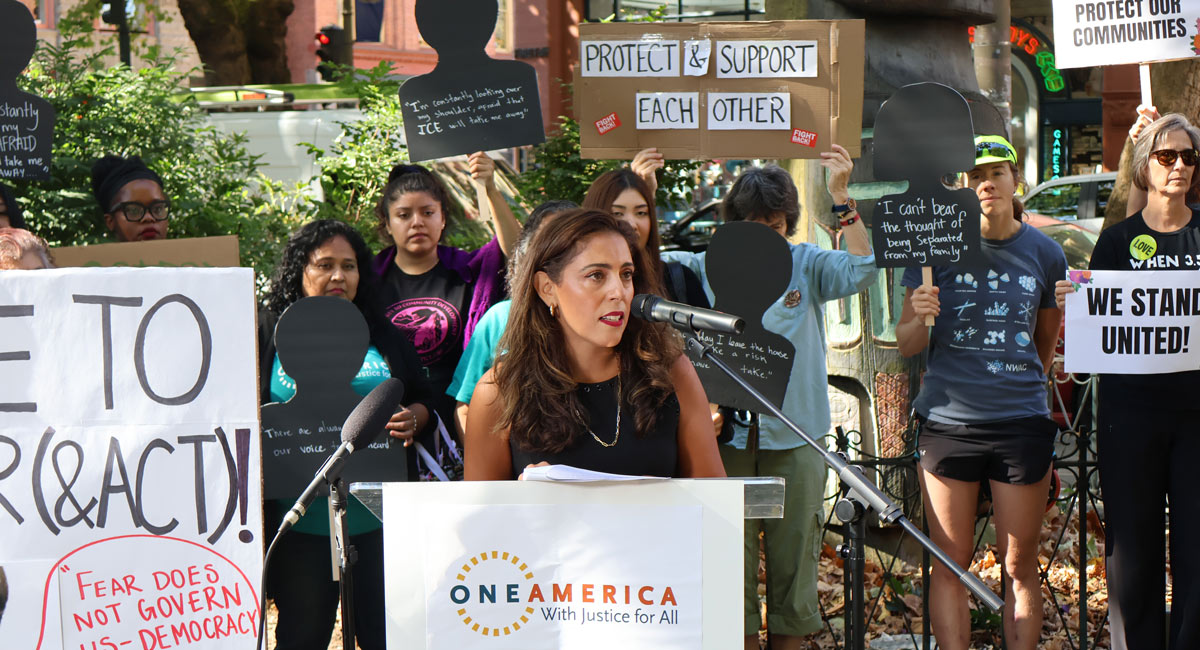
OneAmerica’s executive director Roxana Norouzi speaks at a rally in downtown Seattle, calling for stronger data privacy protections for the state’s immigrants and refugees. Photo courtesy of OneAmerica.

Organizing pays off when state protections fail.

Such worries intensified last year when news reporters discovered that the US Department of Homeland Security had access to sensitive personal data, information that could be used to locate and detain immigrants. The practice went against Washington state’s Keep Washington Working Act, a law designed to limit the transfer of such information to federal immigration authorities.

“People who believed they were protected by state law were suddenly exposed,” said Roxana Norouzi, executive director of OneAmerica.

OneAmerica, which has long sought to empower immigrants and refugees, held a rally with other organizers and spearheaded a response. Weeks later, Governor Bob Ferguson issued an executive order requiring an audit of data-sharing practices across all state agencies. He also created a subcabinet on immigrant and refugee affairs to better coordinate protections and responses. Audits are ongoing.

The moment was an empowering success for OneAmerica, but its work for a more inclusive, safe state continues. It is pushing legislation that would further protect immigrants by restricting the use of automated license plate readers, strengthening enforcement of Keep Washington Working, and requiring employers to tell employees when federal agents plan to check the status of its workforce.

Often people who are fighting deportation were born in refugee camps and would be returning to countries in which they never lived and whose language they don’t speak.

New trauma reopens old wounds.

For Montha Chum, the executive director and cofounder of MN8, advocating for immigrants and refugees has intensified.

Her organization fights deportations of Southeast Asians (Cambodian, Lao, Hmong, Vietnamese, and Karen) in the Twin Cities, often people born in refugee camps who would be returning to countries in which they never lived and whose language they don’t speak. MN8’s caseload has ballooned from about seven people to 100 since the start of 2026, after the federal immigration enforcement surge began.

Most of the people who turn to MN8 for help have convictions dating back 30 or 40 years and have not reoffended. Furthermore, Chum said, the crimes were often nonviolent. Many of the affected individuals had arrived in the US after surviving war and displacement, found few opportunities, and lived in under-resourced neighborhoods. “And now, after building lives and families, they’re being targeted again,” Chum said.

The psychological toll is immense. Elderly parents who survived war feel that the situation in Minnesota now echoes those earlier years. Families fear immigration check-ins that have grown more frequent, knocks at their front doors, warrantless entries, and even the act of going to work or the grocery store, since agents are pulling over drivers to detain people.

blank plug

Family members rally to demand the release of eight Cambodian Americans from Minnesota—collectively known as the MN8—during the #ReleaseMN8 campaign in 2016. Photo courtesy of Thaiphy Phan-Quang.

Community networks step in, offering education, aid, and support.

In response, MN8 has expanded its support: tracking where community members are taken when detained, providing crisis transportation, helping families prepare emergency plans, and accompanying people to immigration hearings. The organization turned its ongoing culturally specific Know Your Rights trainings into webinars and employed an IT security firm to protect data, prevent cyberattacks, combat potential surveillance, and ensure a sense of digital safety for its clients.

Such efforts are unfolding elsewhere, too. OneAmerica combines policy advocacy with trainings to empower and protect immigrants before ICE shows up at their door.

The ACLU of Idaho provides legal aid, training, and support long after the headlines fade. The lawsuit it filed reflects its range, from practical to psychological. “We want to offer a road map on how to combat these kinds of civil rights abuses,” Morales said. “We also want to show people facing these unjust actions that they are not alone, and they are not forgotten. There are people who are with them.”

Across the country, fear may linger—but hope and resilience remain.

“We want to offer a road map on how to combat these kinds of civil rights abuses. We also want to show people facing these unjust actions that they are not alone, and they are not forgotten. There are people who are with them.”

Leo Morales
Executive Director
ACLU of Idaho
Share This Page

Reporting on this story was provided by freelance journalist Kerri Westenberg.