
Get updates, on the When Policy Hits Home series and more
TCUs educate students in rural areas and serve as social, cultural, and economic hubs. They have been struggling under decades of underfunding and are now confronting renewed uncertainty.

Nueta Hidatsa Sahnish College students in the college’s library. Photo courtesy of Nueta Hidatsa Sahnish College.
“The tribal college here on our reservation is embedded in the community. We’re part of the fabric of everything that happens.”
Twyla Baker (Mandan, Hidatsa, and Arikara)
President, Nueta Hidatsa Sahnish College
The tribal college movement emerged during the civil rights era and Native renaissance of the 1960s and 1970s and kept students rooted in their values while developing the next generation of community leaders.

Nueta Hidatsa Sahnish College student harvesting corn in the college’s Four Sisters Garden, where traditional Native plants grow. Photo courtesy of Nueta Hidatsa Sahnish College.
TCUs may be receiving as much as $250 million less annually than the inflation-adjusted funding level authorized under the law. And that could drastically drop.
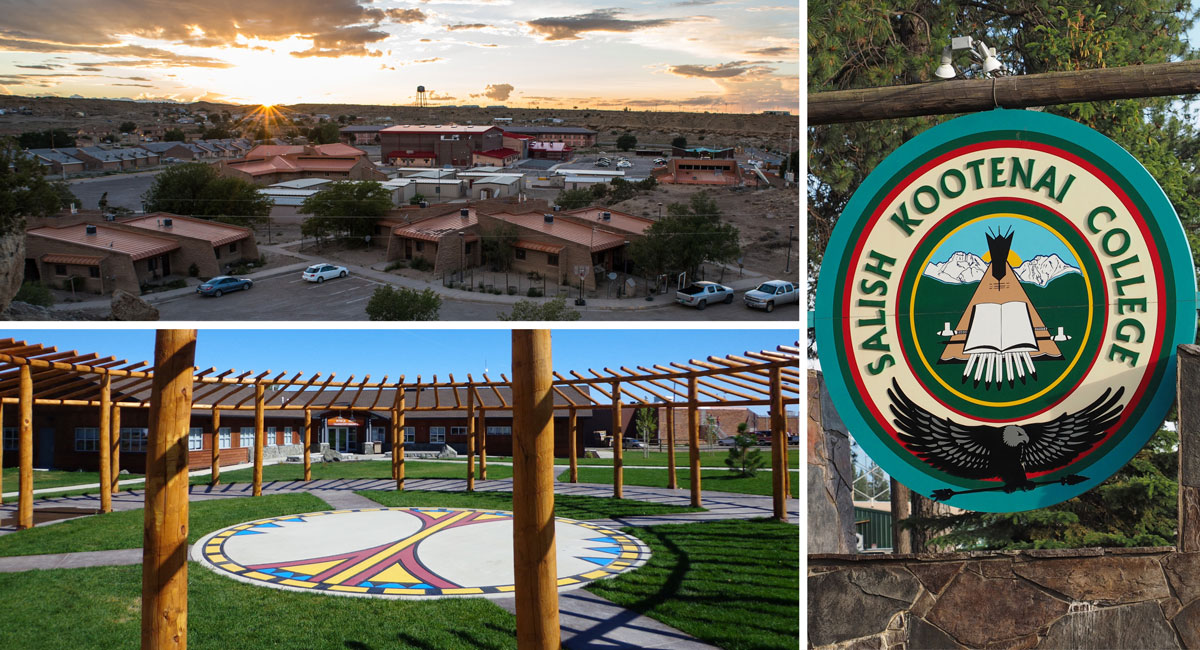
TCU campuses (clockwise from top left): Navajo Technical University, Crownpoint, NM; Salish Kootenai College, Pablo, MT; Aaniiih Nakoda College, Harlem, MT. Photos courtesy of the American Indian College Fund.
“Without tribal colleges, the majority of students would not go to college. You don’t have to remove yourself from your cultural, ceremonial, and social environment.”
Cheryl Crazy Bull (Sicangu Lakota)
President and CEO, American Indian College Fund
Share This Page
Reporting on this story was provided by freelance journalist Kerri Westenberg.